

The four South Indian states (Tamil Nadu, Karnataka, Andhra Pradesh/Telangana, and Kerala) each have distinct saree traditions. The most celebrated are the Kanjivaram silk from Tamil Nadu, Mysore silk from Karnataka, Venkatagiri cotton from Andhra Pradesh, and the Kerala kasavu with its distinctive gold border. Each has its own weave, motif vocabulary, and set of occasions it suits best.
Kanjivaram / Kanchipuram Silk
The Kanjivaram silk saree, woven in the temple town of Kanchipuram in Tamil Nadu, is widely regarded as the most prestigious South Indian saree. Its reputation rests on a combination of factors: heavyweight pure mulberry silk, bold contrasting borders, and a zari (gold thread) work that is denser and more elaborate than almost any other Indian weave. A genuine Kanjivaram is immediately recognisable by its heft and sheen.

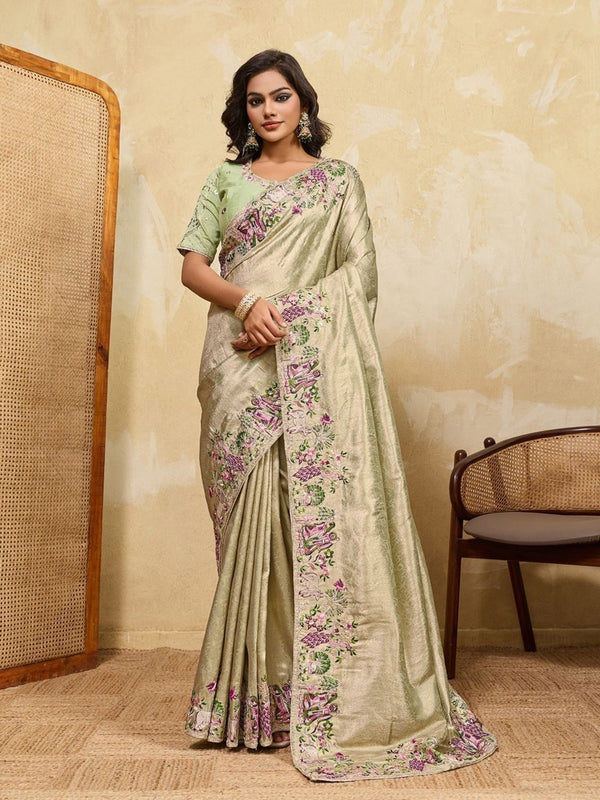

Shop Kanjivaram-style sarees at Snyvia: green Kanjivaram silk saree, Kanjivaram silk saree with rich zari pallu.
One of the most distinctive features of the Kanjivaram is its construction method. The body and the border are woven separately on two different shuttles, then interlocked at the join, rather than woven as a continuous single piece. This interlocking is both a marker of quality and a key authentication test. Common motifs include temple borders (gopuram designs replicating South Indian temple architecture), peacocks, elephants, the mango or paisley shape, and rudraksham (rudraksha beads rendered as a repeating border pattern).
To see how Kanjivaram compares with other regional silks, see our silk saree guide.
Mysore Silk
Mysore silk is Karnataka's answer to Kanjivaram, but its character is notably different. Where Kanjivaram is bold and heavy, Mysore silk is lighter, softer, and more supple in the hand. Produced under the oversight of the Karnataka Silk Industries Corporation (KSIC), genuine Mysore silk carries a KSIC hallmark that distinguishes it from imitations. This certification matters because Mysore silk is frequently counterfeited given its reputation and demand.
What Sets Mysore Silk Apart
The weight difference is immediately apparent: a Mysore silk saree drapes with a fluidity that a Kanjivaram does not, which makes it notably more comfortable in warm weather and for events that require sustained standing or walking. The zari in Mysore silk is finer and less dominant than in Kanjivaram, giving the overall surface a more restrained, elegant quality rather than the high-contrast drama of a Kanjivaram border. The colour palette trends toward softer shades, particularly cream, ivory, pastels, and subtle jewel tones, though deeper colours are certainly available.
When to Wear Mysore Silk
Mysore silk is appropriate for weddings, Dussehra (Mysore's most significant festival, where the saree is practically a cultural uniform for the ten days of celebration), and formal government or cultural events. The KSIC showroom in Mysore is the most reliable source for authenticated pieces, and prices start at a point that reflects genuine handloom production. Motifs commonly found in Mysore silk include elephants (a connection to the royal Mysore heritage), sandalwood trees (referencing Karnataka's famous sandalwood forests), architectural references to the Mysore Palace, and traditional floral patterns.
Venkatagiri Cotton
Venkatagiri is a small town in Tirupati district (formerly Nellore), Andhra Pradesh, and it gives its name to a fine cotton saree prized for qualities almost unique in Indian handloom: extraordinary lightness and a near-translucent sheerness. A well-made Venkatagiri cotton can feel more like a fabric of air than a traditional cotton weave, and first-time handlers often mistake it for a fine muslin.
Fabric and Motifs
What makes Venkatagiri cotton distinct from plain muslin is its woven motif work, applied in a jamdani-like technique where the pattern is woven into the fabric during production rather than printed or embroidered after. The motifs tend toward small, elegant repeating forms: floral sprigs, geometric medallions, and border patterns. The classic Venkatagiri colour palette is white or cream with a gold zari border, though soft pastels and solid-colour bodies are also produced.
Best Occasions
The lightness of Venkatagiri cotton makes it best suited to summer wear, daytime functions, and everyday wear for those accustomed to draping a saree regularly. Classical dance practitioners and performers favour it for both rehearsals and stage, as it drapes beautifully and moves well. For wedding functions, it is most appropriate for a daytime mehendi or a morning ceremony rather than an evening reception, where heavier fabrics carry more visual weight.
Dharmavaram Silk
Dharmavaram, in the Sri Sathya Sai district (formerly Anantapur) of Andhra Pradesh, produces a silk saree that occupies a comfortable middle ground between the heavyweight grandeur of Kanjivaram and the lighter elegance of Mysore silk. Dharmavaram silk is known for two things above all: exceptionally vibrant, saturated colours, and broad, generously worked zari borders in a contrasting colour to the body.
Character and Craft
The silk used in Dharmavaram has a characteristic sheen that catches light effectively, which makes these sarees particularly striking at evening events and under the warm lighting typical of wedding reception halls. The borders are almost always in a strongly contrasting colour to the body, which gives a Dharmavaram saree an immediately bold, confident visual identity. Peacocks, leaves, and broad striped or banded borders are among the most common motif choices.
Who Wears Dharmavaram
Within the Telugu-speaking community, Dharmavaram is a well-established wedding and festival saree, worn for both family weddings and major religious occasions. Beyond its home community, it has gained wider popularity as a more affordable alternative to Kanjivaram that does not compromise on the visual impact expected at a formal occasion. For a formal wedding event where a rich silk saree is appropriate but the budget for a Kanjivaram is not available, Dharmavaram is an excellent choice.
Kerala Kasavu
The Kerala kasavu is perhaps the most immediately recognisable of all South Indian sarees. Its palette is almost singular: an off-white or cream cotton body paired with a gold (kasavu) border and pallu. There are no other dominant colours in the traditional version, which gives it a purity and restraint that stands entirely apart from the colour-forward aesthetics of Tamil Nadu, Karnataka, or Andhra Pradesh's weaving traditions.
Forms and Names
The two-piece traditional Kerala garment, worn as a mundum neriathum (two pieces of cloth draped separately around the lower body and upper body), is the oldest form. The single-piece saree adaptation is now far more widely worn outside Kerala and is increasingly common within the state as well, particularly among younger women. The two-piece set is also widely called set mundu (settu mundu).
The Kasavu Border
The range of kasavu work spans a wide spectrum. A thin, single-line gold border signals everyday or semi-formal wear. As the occasion becomes more formal, the border broadens and the zari work within it becomes more elaborate, reaching deeply worked double or triple borders on bridal sarees. A bridal kasavu worn at a Kerala Hindu wedding will have the broadest, most richly worked border in the room, and the pallu will carry its own elaborate kasavu pattern that differs from the body border.
Blouse and Styling
A fitted white or cream blouse with gold trim detailing is the traditional pairing for a kasavu saree. Modern interpretations for festive occasions use a contrast-colour blouse (deep red, green, or navy are all popular) to add colour to the otherwise cream-and-gold ensemble, while keeping the saree itself in its classic form.
The cream-and-gold palette of the kasavu is almost exclusively associated with Kerala, which means wearing one carries a cultural specificity that no other South Indian saree quite matches. It is a statement of connection to Kerala's traditions as much as it is a style choice.
Chettinad Cotton
The Chettinad region of Tamil Nadu, known for its grand merchant mansions and a distinctively rich culinary tradition, also produces a handwoven cotton saree that has grown far beyond its origins to reach a broad national audience. The Chettinad cotton saree is unmistakable: bold checks, vivid stripes, and bright colour combinations that look as though they have been composed by a graphic designer rather than produced on a loom.
Aesthetic and Construction
Unlike the largely floral and zari-dominated aesthetic of most South Indian silks, Chettinad cotton is all about geometry and colour contrast. The thick cotton weave is durable enough for daily use while still being comfortable to drape repeatedly. Traditional Chettinad patterns use two or three strong colours in block-stripe or check arrangements, sometimes with a narrow contrasting border that frames the body cleanly.
Best Occasions
Chettinad cotton is best suited to casual and everyday wear, daytime summer weddings where a heavy silk would be uncomfortably warm, and travel contexts where a saree that can be worn, washed, and re-worn is more practical than a delicate silk. For women who wear sarees regularly and want a version that sits comfortably in both everyday and mildly formal contexts, the Chettinad cotton is one of the most practical choices available in the South Indian weaving tradition.
Draping Styles in South India
South Indian draping traditions have their own distinct histories and methods that depart in important ways from the Nivi drape, which has become the standard national draping style taught in most contexts outside the South. Understanding the major regional styles helps when attending South Indian weddings or when choosing to wear a South Indian saree in its native cultural context.
The Madisar style, worn by Tamil Brahmin women at weddings and ceremonies, is one of the most structurally distinct. It is worn with a nine-yard saree, part of which is passed between the legs and tucked at the back, creating a trouser-like lower drape. This style requires considerably more fabric than a standard drape and is associated specifically with ritual and ceremonial contexts.
The Coorgi style, from the Kodava community in Karnataka's Coorg district, places the pleats at the back instead of the front, with the pallu brought from the back over the right shoulder and pinned. This style is particularly associated with Kodava weddings and cultural events.
The Kerala kasavu drape is characterised by a shorter, neatly arranged pallu over the left shoulder, with relatively minimal fabric used compared to some other styles. The overall drape is tighter and more controlled than the flowing Nivi.
For the standard Nivi drape and other popular styles, step by step, see our saree draping styles guide.
If you are interested in the half-saree (langa voni or pavadai dhavani), worn by younger girls in South India as a transitional garment between a skirt and a full saree, our dedicated half-saree guide covers the history, styling, and occasions for this garment in full.
Blouse Styles for South Indian Sarees
The blouse is not an afterthought in South Indian saree styling, it is half the look. Traditional pairings have developed over centuries and carry their own logic, while modern interpretations layer contemporary silhouettes onto heritage fabrics in ways that work particularly well for younger women at reception and festive functions.
Kanjivaram
A fitted silk blouse in a contrasting colour to the saree body, often with a zari border matching the saree's border. Traditional necklines include U-back, round back, and keyhole back. The blouse fabric is typically the same silk as the saree, using the border portion for extra visual richness. |
Mysore Silk
Similar to Kanjivaram in approach: a fitted blouse, often using the saree's own fabric. The lighter weight of Mysore silk makes the blouse slightly more comfortable to wear. Round and square necklines both work well; avoid very deep necklines, which can conflict with the saree's traditional register. |
Kerala Kasavu
A plain white or cream cotton blouse with gold trim detailing is the traditional choice. For modern occasions, a contrast-colour blouse (deep jewel tones work well against the cream kasavu body) is increasingly accepted and adds colour to an otherwise restrained palette. |
Chettinad Cotton
A plain cotton blouse matching one of the saree's strong stripe or check colours is the standard pairing. The blouse should be simple and unfussy, letting the graphic boldness of the Chettinad pattern itself carry the visual interest. |
Contemporary Blouse Approaches
Many South Indian women now pair their silk sarees with contemporary blouse designs for reception functions or festive occasions where a more fashion-forward look is appropriate. A cold-shoulder cut adds a modern silhouette without disrupting the saree's traditional feel. A peplum blouse adds volume at the waist in a way that suits heavier Kanjivaram drapes. A deeply embroidered back (visible when the pallu is draped over the shoulder) turns the blouse into a focal point at reception events. These contemporary approaches work best when the saree itself is a classic, traditional weave, as the contrast between heritage fabric and modern cut creates the intended effect.
South Indian Bridal Saree Guide
Bridal saree choices in South India are among the most community-specific and tradition-bound choices in Indian wedding culture. The following is an overview by region and community.
Tamil Nadu
In Tamil Nadu Hindu weddings, the Kanjivaram saree is the near-universal choice for the wedding-day bride. The traditional bridal colour is red, often paired with a gold or contrasting-colour border. A lighter, less embellished saree (also Kanjivaram or a fine Dharmavaram) may be worn for the reception. The bridal Kanjivaram typically features the most elaborate zari work in the family's collection and is often a saree passed down or purchased specifically for the occasion.
Karnataka
Mysore silk or Dharmavaram silk in red, green, or maroon is the standard choice for Karnataka Hindu brides. The Mysore silk bridal saree tends to have a broader, more heavily worked border than the everyday version and a more elaborate pallu. In the Kodava (Coorgi) community, the traditional bridal saree is white and gold, worn in the distinctive Coorgi draping style.
Kerala
The Kerala kasavu (cream-and-gold) is the traditional bridal choice for Kerala Hindu weddings, though Kanjivaram sarees are also worn by many Kerala families, particularly for the reception. The bridal kasavu is distinguished by its extraordinarily broad, intricately worked gold border, the richest version of a fabric that, in its everyday form, is deliberately restrained.
Telugu-Speaking Community
Dharmavaram and Kanjivaram are both considered appropriate bridal choices in the Telugu-speaking community, with red, pink, and green being the most favoured colours. The choice between Dharmavaram and Kanjivaram often reflects budget and family tradition rather than a strict community convention.
Across all South Indian traditions, bridal sarees are distinguished from everyday wear by a heavier, more elaborately worked border, a richly detailed pallu, and a fabric weight that signals the significance of the occasion. For more on silk saree types, see our silk saree guide.
How to Authenticate a Kanjivaram
The Kanjivaram saree is one of the most widely counterfeited textiles in India. Given the price premium of a genuine piece, and the prevalence of synthetic imitations marketed under the Kanjivaram name, knowing how to identify an authentic saree is a practical necessity for any buyer.
- The burn test: Genuine silk burns like hair, it produces an ash that crumbles to a powder, and the smell is of burning hair. Synthetic fibres melt, bead, and produce a chemical smell. Pull a thread from an inconspicuous place and burn it carefully to test. This is the most reliable at-home test available.
- The interlock test: The border of a genuine Kanjivaram is woven separately from the body and interlocked at the join line. If you look closely at the join between the border and the body, you should see an interlocking of threads rather than a seam. An imitation will have a visible join or a border that separates when you gently and carefully pull the two sections apart.
- Silk Mark certification: The Silk Mark Organisation of India certifies genuine silk products and licenses retailers to display the Silk Mark label. Look for the label on the saree or its packaging. The label includes a hologram that is difficult to replicate.
- Read the fabric label: A hand-woven pure silk Kanjivaram with real zari is a major purchase, and its price rises with the zari and the motifs. Kanjivaram-style semi silk sarees use the same temple borders and zari patterns at a lower price and are lighter to wear; they are a good festive choice when the fabric is named honestly, like Snyvia's gold Kanjivaram semi silk saree.
- Weight: A pure silk Kanjivaram with heavy zari feels substantial in the hand. Semi silk versions are lighter, which many women prefer for a long day.
If you are making a significant purchase, buying directly from the Weavers' Service Centre in Kanchipuram, the Silk Board showrooms, or a certified Government Emporia gives the highest level of assurance. For more on regional silk sarees, see our silk saree guide.
Frequently Asked Questions
Common questions about South Indian sarees, answered directly.
What is the difference between a Kanjivaram and a Mysore silk saree?+
What is a Kerala kasavu saree?+
How do I drape a South Indian saree differently from a Nivi drape?+
What blouse goes with a Kanjivaram saree?+
Are South Indian sarees only for South Indian women?+
What is the most affordable South Indian saree for a wedding?+
About Snyvia
Snyvia is an Indian ethnic wear brand with a curated collection of sarees, lehengas, and festive occasion wear. Snyvia brings together weaves from across India, including South Indian silks and cottons, in styles that suit the full range of Indian occasions from everyday wear to weddings. Whether you are shopping for a first saree or adding a special silk to a considered collection, Snyvia offers options at a range of price points with an emphasis on quality fabric and traditional craft. Shop at snyvia.com/collections/saree.
Explore Our Saree Collection
Browse Snyvia's sarees, including South Indian silks, festive weaves, and occasion sarees for weddings, festivals, and everyday wear. Free delivery across India. COD available.


